
Investors will take cues from the December quarter corporate earnings, with blue-chips like Infosys, Reliance Industries scheduled to report their results this week, in addition, inflation data and trading activity of foreign investors will also be crucial in dictating market trends, analysts said.

Overall, the Brazil, Russia, India, China and South Africa gap has widened as developed economies are taking the lead.

A massive drone strike on the world's largest crude-processing facility operated by Saudi Arabia's Aramco has driven oil prices to their highest level in nearly four months. The attack has knocked out over half of Saudi Arabia's production as it cut 5.7 million barrels per day or over 5 per cent of the world's supply.

India is preoccupied with analysing the US sanctions, which may cut off India's access to discounted Russian crude and force it to buy at market prices.

Equity markets this week will turn their focus on the RBI's interest rate decision, Q1 earnings from several blue-chip firms and tariff-related news for further cues, analysts said. Moreover, trading activity of foreign investors and trends in global equity markets will also drive investors' sentiment.

Trends in the global energy markets are crucial if India's growth outlook is to remain healthy. Prices for the Indian crude basket were averaging around $86.2 per barrel through Q1FY25 and then moderated to $84 in July and to $78-79 in August (so far). But global crude supply may outpace weak global demand in the short term.

'Trade deal will act as a strong trigger for market sentiment, not just for domestic investors but also for FIIs.'

'The world is heading into a period of serious problems, and gold and silver are among the few ways to protect oneself.'
From the 30-share blue-chip pack, Bharti Airtel, Power Grid, Bajaj Finance, Nestle, Mahindra & Mahindra, Reliance Industries, Asian Paints, IndusInd Bank, Hindustan Unilever and HDFC Bank were the biggest gainers. Bajaj Finance climbed nearly 2 per cent after the company reported an 18 per cent increase in its consolidated net profit to Rs 4,308 crore for the December quarter.

The outcome of the Union Budget, quarterly earnings from corporates and global trends are the major factors to drive stock market sentiments this week, analysts said. Besides, the trading activity of foreign investors, the rupee-dollar trend and the movement of global oil benchmark Brent crude are also crucial aspects to watch out for.

The Andhra Pradesh government has prepared an action plan for relief and essential supplies in pre-cyclone preparedness for Cyclone Montha, expected to cross the coast on October 28.
Stock markets are in for an event-heavy week ahead with a raft of Q1 earnings from blue-chips, the US Fed interest rate decision and foreign investors trading activity driving investors' sentiment, analysts said. Macroeconomic data announcements, monthly auto sales numbers and global market trends would also guide movement in the domestic equities, they said.

The government has raised the windfall profit tax levied on domestically produced crude oil as well as on the export of diesel and ATF, in line with firming international oil prices, according to an official order. The levy on crude oil produced by companies such as Oil and Natural Gas Corporation (ONGC) has been increased to Rs 2,100 per tonne from Rs 1,700 per tonne, the order dated January 2, said. Crude oil pumped out of the ground and from below the seabed is refined and converted into fuel like petrol, diesel and aviation turbine fuel (ATF).

Last month, Indian Oil Corp, Bharat Petroleum and Hindustan Petroleum were losing Rs 390 crore (Rs 3.9 billion) per day on sale of petrol, diesel, kerosene and domestic LPG. This month, losses have come down to Rs 352 crore (Rs 3.52 billion) per day, an industry official said.

Equity benchmark indices Sensex and Nifty settled lower for the sixth straight session on Monday due to heavy selling in bellwether stocks including HDFC Bank and Reliance Industries amid mixed trends in the global markets and outflow of foreign funds. Falling for the sixth consecutive session, the BSE Sensex tumbled 638.45 points or 0.78 per cent to settle at 81,050. During the day, it plummeted 962.39 points or 1.17 per cent to 80,726.06. The NSE Nifty slumped 218.85 points or 0.87 per cent to end at 24,795.75.

'The US is strongly placed to expand its crude supplies to India.'

'India is cosying up to Xi Jinping. They don't need the Russian oil. It's a refining profiteering scheme.'

Benchmark stock indices Sensex and Nifty declined on Monday, extending the losing run to the fourth day amid selling in IT shares and foreign fund outflows. The 30-share BSE Sensex dropped by 247.01 points or 0.30 per cent to settle at 82,253.46. During the day, it fell 490.09 points or 0.59 per cent to 82,010.38 but recovered some of the losses towards the close.
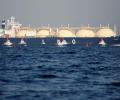
With India making it clear that the US doesn't have enough spare capacity for crude oil, Washington, DC, now wants India to sign fixed-term liquefied natural gas (LNG) contracts with American producers, multiple sources in the know said.

The Israel-Iran conflict has entered a 'decisive phase' after the United States bombed three major Iranian nuclear sites Sunday morning, feel strategic affairs experts with some of them arguing it was Washington, DC's 'responsibility' to not get involved in the military standoff.

'Geopolitical stability could remove the crude oil risk premium.'

Stock markets snapped the four-day falling streak on Tuesday with the benchmark Sensex rebounding by 317 points on buying in auto and pharma shares amid a decline in retail inflation to a more than six-year low, nearing the RBI's comfort zone. The 30-share BSE Sensex climbed 317.45 points or 0.39 per cent to settle at 82,570.91. During the day, it jumped 490.16 points or 0.59 per cent to 82,743.62. The 50-share NSE Nifty edged higher by 113.50 points or 0.45 per cent to 25,195.80.

Investors are showing some interest in the downstream energy cycle. Refiners and marketers, especially the public sector (PSU) oil marketing companies (OMCs) could see a revival of marketing margins. Lower crude oil and gas prices may also improve margins in industries like paints, logistics, synthetic fabrics, plastics, and fertilisers. In the medium-term, however, there could be a supply overhang affecting OMCs as new refining capacities are scheduled to be commissioned, especially in China, and this may lead to a drop in the refining margins as capacity would be surplus to demand until and unless there's a pick-up in global growth.


India's crude oil import bill is set to exceed $100 billion in the current fiscal year ending March 31, almost double its spending last year, as international oil prices trade at seven-year highs. India spent $94.3 billion in the first 10 months (April-January) of the ongoing financial year that started April 1, 2021, according to data from the oil ministry's Petroleum Planning & Analysis Cell (PPAC). It spent $11.6 billion in January alone when oil prices had started to surge.
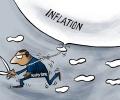
'Deposit and lending rates have started to fall considerably. It is likely to spur investment and consumption of durables.'
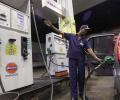
Petrol and diesel prices are likely to be hiked this week as oil companies prepare to pare losses accumulated from keeping rates steady for over four months in the run-up to assembly elections in five states, including UP, despite international oil prices jumping to a 13-year high of $140 per barrel. West Texas Intermediate crude futures, the US oil benchmark, rose to $130.50 per barrel on Sunday evening, its highest since July 2008, before retreating. The international benchmark, Brent crude, hit a high of $139.13 at one point overnight, also its highest since July 2008.
With global oil rates softening, state-owned oil companies may next week cut petrol price by about Rs 0.80 per litre which could be the first reduction since January 2009.

Major laggards among Sensex constituents included Bharti Airtel, Hindustan Unilever, Tata Steel and ITC. Power Grid, UltraTech Cement, NTPC and Titan emerged as winners.
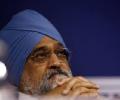
Planning Commission Deputy Chairman Montek Singh Ahluwalia on Wednesday expressed concerns over rising crude prices which soared to two-year high of $ 102 a barrel in Asian markets.

International oil prices retreated from an over seven-year high but was still above $100 a barrel and continue to pose threat to India's inflation rate and current account deficit. While there are no supply concerns as the oil route remained open, consumers will feel the pinch when PSU oil firms start passing on the increase in international rates through a revision in petrol and diesel prices, which have been on a pause for over three-and-a-half-months in view of elections in Uttar Pradesh and four other states. The government is "closely monitoring the situation" and will "take appropriate steps as and when required", a top official said. Brent crude oil surged past $105 per barrel on Thursday for the first time since August 2014, following Russia's invasion of Ukraine.

Usually, a fall in oil prices is followed with a cut in retail prices of auto fuels and the government passes on the benefit to consumers. However, Morgan Stanley believes gains this time around will remain capped.

The Reserve Bank on Friday raised the inflation projection for current fiscal year to 4.8 per cent from 4.5 per cent with Governor Shaktikanta Das saying lingering food price pressures are likely to keep headline inflation elevated in the December quarter. Consumer price index (CPI)-based inflation increased sharply in September and October 2024 led by an unanticipated increase in food prices.

The prospect of protracted uncertainties in the global economic landscape not only pose a risk for India's growth outlook in 2025-26, but are also likely to dent the private sector's capital raising and investment plans, the finance ministry averred on Tuesday, cautioning the country's corporates that the era of 'easy pickings' was over.
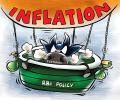
The Reserve Bank on Wednesday lowered the inflation projection for the current fiscal to 4 per cent from 4.2 per cent earlier, taking into account good agricultural output and falling crude prices.

From the Sensex firms, Tata Steel, Eternal, Tech Mahindra, Maruti, Mahindra & Mahindra, Infosys, IndusInd Bank, HCL Tech, Tata Consultancy Services and Bharti Airtel were the major gainers. Telecom operator Bharti Airtel climbed nearly 1 per cent after it posted about a five-fold jump in consolidated net profit to Rs 11,022 crore in the March 2025 quarter, mainly due to the tariff hike impact and one-time gain on tax benefits. However, Asian Paints, Tata Motors, Kotak Mahindra Bank, NTPC and Power Grid were among the laggards.
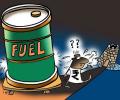
A swift recovery in oil demand in India is not only helping the stability of the global market, it is giving huge fiscal headroom to the government in terms of additional excise duty.

The Asian Development Bank (ADB) on Wednesday lowered India's growth forecast for FY26 to 6.5 per cent from 6.7 per cent on account of trade uncertainty and higher US tariffs that are expected to impact exports and investment. Despite the downward revision from the April 2025 Asian Development Outlook (ADO), India remains one of the fastest-growing major economies in the world.
Indian Oil Corporation sought an increase in prices of petrol, diesel, domestic LPG and PDS kerosene on Tuesday as spiralling global oil prices had put "enormous" burden and may result in a revenue loss of over Rs 8,500 crore (Rs 85 billion) this fiscal. While the government and oil companies were bearing their share of the burden, the consumers have so far been spared from any hike in fuel prices despite crude oil touching a historic high of $93 per barrel.
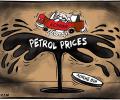
Petrol and diesel prices on Thursday climbed to fresh highs in the country as rates were hiked by the most in recent times, even as fuel retailers said the government can cut taxes to ease consumer burden. Petrol and diesel price was hiked by 35 paise per litre each after a gap of a week, according to price notification of state-owned fuel retailers. The increase took petrol prices to a fresh high of Rs 86.65 a litre in Delhi and to Rs 93.20 in Mumbai.
